Courts · PTM
PTM ban challenge: Peshawar High Court reserves its verdict
More than a year after the federal government proscribed the Pashtun Tahafuz Movement, the High Court heard detailed arguments on whether the ban, and the listing of its leaders, can be squared with the constitutional right to a fair trial.
· By My Safe Voice
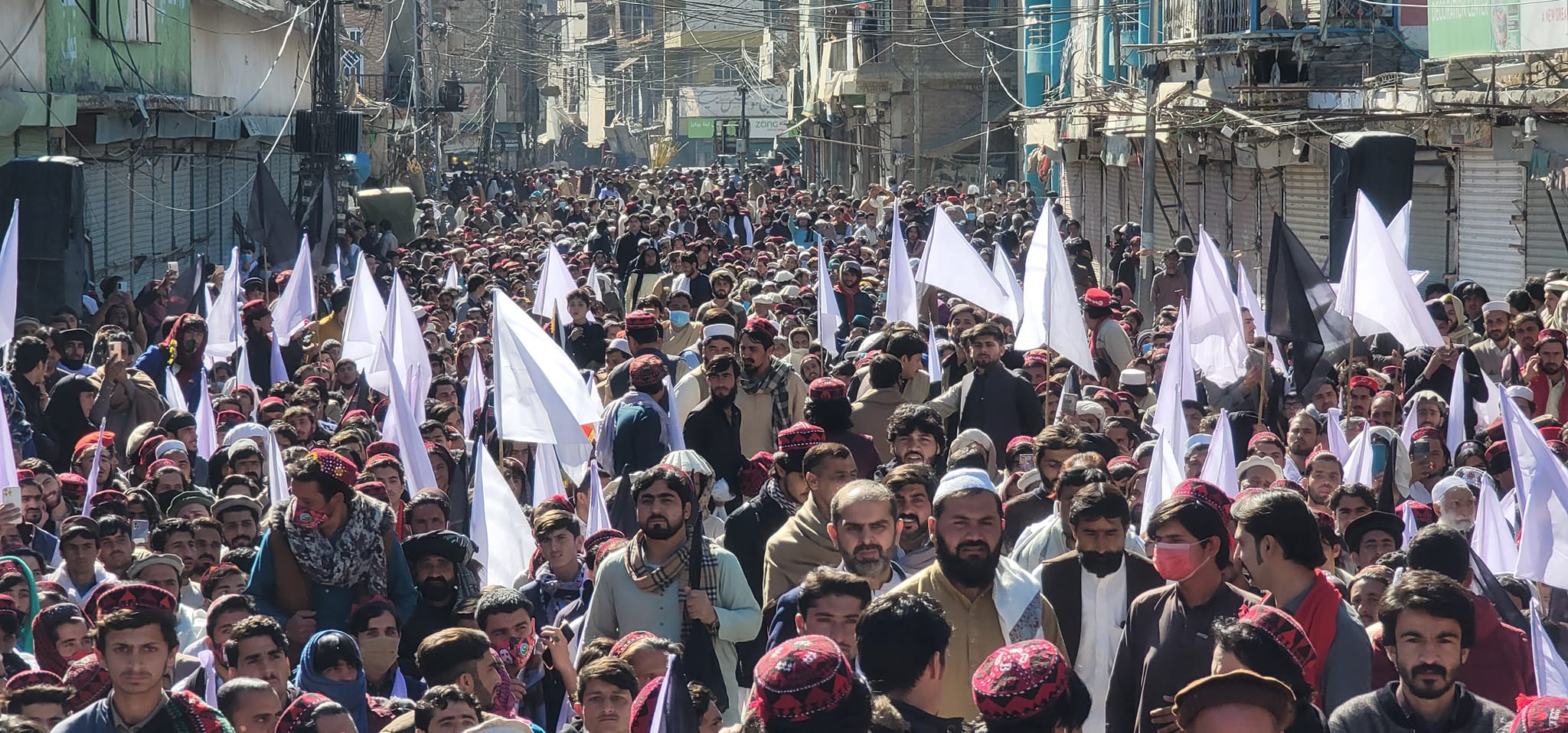
On 21 January 2026, a two-judge bench of the Peshawar High Court, comprising Justice Sahibzada Asadullah and Justice Dr Khurshid Iqbal, heard two near-identical petitions and reserved its order. The petitions challenge the federal government's notification of 6 October 2024 that declared the Pashtun Tahafuz Movement (PTM) a proscribed organisation.
What the petitioners are asking
- That the ban under Section 11B of the Anti-Terrorism Act, 1997 be declared illegal, and the movement removed from the First Schedule of the Act;
- That the names of PTM leaders be removed from the Act's Fourth Schedule;
- That Sections 11B and 11EE, introduced by the Anti-Terrorism (Amendment) Act, 2014, be declared in conflict with Article 10-A of the Constitution, which guarantees the right to a fair trial and due process;
- That Section 11D, which allows an organisation to be placed under observation, be read as a mandatory precondition before any proscription under Section 11B.
One petition was filed jointly by Manzoor Pashteen and nine other leaders; the second by a PTM member, Masoom Shah, challenging the October 2024 notification directly. The petitioners describe the movement as non-violent and say its suppression is a political act rather than a security measure.
The PTM "has never resorted to violence and always used the framework of the Constitution to advocate its cause.", Human Rights Commission of Pakistan
The wider record
The case is one of the few formal routes through which the movement's suppression can be examined on the record. In March 2025, the High Court had ordered the federal government to produce the cabinet minutes relating to the proscription, in response to an earlier petition filed by Pashteen and others against the ban and the designation of an estimated 250 leaders.
During the January 2026 hearing, the additional attorney general submitted a sealed report stating it contained sensitive information for the court's perusal. The government has not, in public, produced concrete evidence that the movement engaged in violence; Amnesty International noted that the ATA permits designation on the basis of "information received from any credible source," and criticised the absence of supporting evidence.
Because membership of a proscribed organisation is itself a criminal offence under the Act, the outcome matters well beyond the leadership. A designation can expose thousands of ordinary members and sympathisers to up to six months' imprisonment simply for associating with the movement, and, rights groups argue, to the kind of disappearance documented in the cases of Hanif Pashteen and Noor Ullah Tareen.
The legal principle at stake
Article 10-A, inserted in 2010, guarantees a fair trial and due process. The petitioners' core argument is that a designation process with no chance to answer the allegations, and a ban based on undisclosed "sources," cannot be reconciled with that guarantee. Read Courts, custody and due process.
Sources
- "Peshawar High Court reserves order on petitions against ban on PTM, its leaders", Dawn, 22 January 2026.
- Amnesty International, statement on the PTM proscription, October 2024.