Disappearances · Analysis
What Pakistan's own disappearance commission admits
You do not have to take activists' word for it. The state's own Commission of Inquiry on Enforced Disappearances publishes a monthly tally. Read carefully, it is an indictment written by the government itself.
· By My Safe Voice
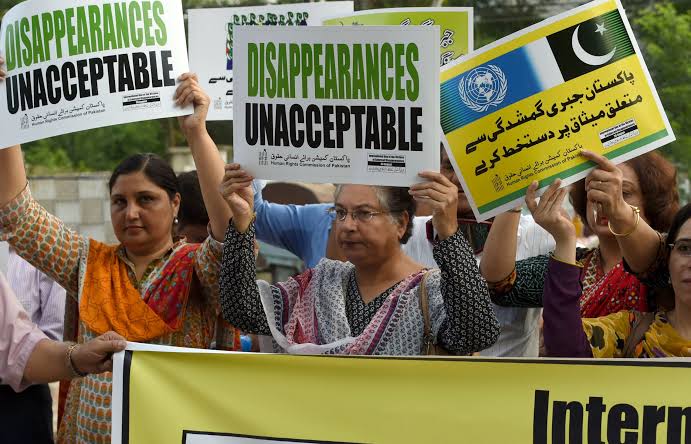
In its monthly report released at the start of October 2025, Pakistan's Commission of Inquiry on Enforced Disappearances (COIED) said it had received 10,636 cases since its establishment in March 2011. It had disposed of 8,986 of them and 1,650 remained under investigation. In September alone it disposed of 113 cases and recorded that 14 missing people had returned home.
Those are the government's numbers. They matter because they come with an implicit admission: that a state body exists specifically to handle a category of cases in which people are taken and their whereabouts denied, and that, after more than a decade, well over a thousand such cases are still open.
The number that never goes to zero
Disposal is not the same as justice. Independent monitors point out that a large share of "disposed" cases are closed because the person was later found dead, traced to a prison, or classified as never having been an enforced disappearance at all. In August 2025, a joint statement by eight civil-society organisations marked the International Day of the Victims of Enforced Disappearances by describing the Commission's record bluntly: while it has issued hundreds of "production orders" compelling authorities to bring a detainee before a court, only a handful have ever been complied with, and there have been no prosecutions in the cases reported to it.
Over 700 production orders have been issued to date; only a handful have been complied with. Families have waited as long as six years for an order to be enforced.
Who the numbers are made of
Civil-society documentation consistently shows that disappearances cluster in the same communities. Amnesty International's August 2025 statement noted that Defence of Human Rights (DHR) had documented 3,140 cases since 2006, of which 1,362 victims remained forcibly disappeared. In the first half of 2025, the Baloch Yakjehti Committee reported 546 cases, the Pashtun Tahafuz Movement documented 133, and Voice for Missing Persons of Sindh reported 40.
The geographic pattern is not accidental. Balochistan and Khyber Pakhtunkhwa, including the former tribal districts, account for the overwhelming majority of complaints. Enforced disappearance in Pakistan is not a random crime; it is a political instrument, and the people it is used against are largely those from regions the state treats as suspect.
A legal gap that protects the practice
Enforced disappearance is still not codified as a standalone crime under Pakistani law. A 2021 amendment bill that would have created such an offence passed the National Assembly but stalled in the Senate. Pakistan is also not a party to the International Convention for the Protection of All Persons from Enforced Disappearance (ICPPED), which would create binding duties to search, to inform families and to provide reparation.
During the same period, the Islamabad High Court has held that the state bears a positive obligation to trace a disappeared person once there is prima facie evidence of enforced disappearance, a principle that remains, in practice, thinly applied.
What this means for a family
A government tally is useful evidence. If your relative is missing, record the date, place and circumstances precisely, register an FIR for kidnapping where possible, and file with the Commission and through a habeas corpus petition. Our guide explains each step: If a relative is disappeared.
Sources
- "Commission disposes of 113 missing person cases in 14 years", Dawn, 4 October 2025.
- Commission of Inquiry on Enforced Disappearances monthly report, September 2025 (as reported by Dawn, 3 October 2025).
- "Failure to address enforced disappearance perpetuates injustice against victims", joint statement by eight Pakistani human-rights organisations, published by Amnesty International, 30 August 2025.